Contributor Dossier
Oliver Ferran
Independent researcher based in Mexico. Chemical engineer and economist. He is currently pursuing a Master’s degree in Economic Sciences. He is a member of the Laboratory for the Study of Transnational Corporations at the Institute for Economic Research (IIEc), National Autonomous University of Mexico (UNAM), and the seed node of Crítica Acelerada. His research focuses on collapsology, critical accelerationism, and the political economy of data.
Substack: @ferracianuro91
X: @ferracianuro
Instagram: @ferracianuro
Correo electrónico: [email protected]
Laboratory Note
The year 1977 marked the beginning of the “No future” that the Sex Pistols shouted through God Save the Queen across the United Kingdom, as a protest against the British monarchy but also as a sign of a political horizon that seemed to have expired. Thatcherism would later appropriate that slogan, feeding it into the capitalist machinery and transforming it into another: “There Is No Alternative.” This became the imaginary of everything that would eventually be placed inside the box labelled “neoliberalism”: an economic programme oriented towards unrestricted free trade and limited state intervention.
Because there was no alternative other than the anarchy of capitalist competition.
The reactor of infinite production devoured formal subsumption and expelled real subsumption.
In the decades that followed, that programme infiltrated and conditioned not only the economic sphere, but also the political and the cultural. As Fredric Jameson had already written in The Seeds of Time (1994):
“It is easier to imagine the end of the world than the end of capitalism.”
Mark Fisher and Slavoj Žižek would later return to this idea in order to show that capitalism had subsumed even our political and existential imagination.
That was the diagnosis.
The future ceased to be a promise.
It became repetition.
Capitalism had left the past behind.
It controlled the future.
From there, it governed the present.
There is no alternative:
Capitalism or death.
In the twenty-first century, those suspicions and intuitions began to acquire greater critical mass, as the multiple crises traversing our present — ecological, economic, energy-related, technological, geopolitical, and social — transformed what had long appeared to be a philosophical intuition into a genuine research problem.
The system’s multiple configurations and deviations seem to point towards a return to the fundamental conditions of existence.
“Labour, therefore, is not the only source of the use-values it produces, of material wealth. Labour is the father of material wealth […] and the earth is its mother.”
— Karl Marx, Capital
The impasse of contemporary society can no longer be reduced to crisis as an all-purpose category: the concept that once seemed capable of naming everything. Perhaps it is precisely this insufficiency that explains why, across very different fields of research, another word has begun to force its way into view: collapse.
Time to leave the comfort zone.
But What Exactly Do We Mean When We Speak of Collapse?
This is the point of departure for this dossier.
I. Introduction
A certain conceptual plasticity has developed around the use of the word crisis as a means of describing virtually any emergency within capitalism: financial crisis, energy crisis, ecological crisis, migration crisis, social crisis, economic crisis, and so on. The term functions as a catch-all category, capable of naming both a recession lasting a few months and the increasingly inhospitable conditions that make particular regions of the planet progressively more difficult to inhabit.
This is not to say that the definition of crisis is false. It has possessed the necessary characteristics to designate particular phenomena. In medical terms, a crisis opens a field of possibilities and alternatives for recomposition. Nor can we deny the capitalist machine’s capacity to convert any event or form of existence into a zone of valorisation. This capacity for reorganisation — for deterritorialisation and reterritorialisation — is intrinsic to it. The history of the system bears witness to this perfect machine of action: crises constitute a mechanism through which capitalism renews the conditions of accumulation.
Yet if we remain trapped today within the dictum that “There Is No Alternative”, it is precisely because the word crisis no longer appears sufficient to comprehend contemporary problems.
The problem of water scarcity in particular regions of the Global South cannot today be understood without attending to its connections with large transnational capitals that circumvent environmental regulations in states where governmental laxity becomes a condition for securing a small portion of extraordinary profits. To this must be added the effects produced within local markets and the population displacements that water scarcity itself may generate.
No problem remains isolated.
Each amplifies the others.
The problem has acquired a different degree of complexity. It is no longer sufficient simply to identify one crisis among the many that exist.
At this point, one of our most powerful tools once again becomes relevant: language.
The confinement of the word collapse to cinematic and catastrophist imaginaries has begun to break down, allowing the term to enter research spaces. Collapse should be reduced neither to the dystopian nor to the messianic.
In this initial approach, Crítica Acelerada does not intend to rush towards ethical judgement. Its purpose is to map the present state of the system. In doing so, we do not seek to demonstrate that collapse is inevitable. Nor do we intend to defend yet another variation of the catastrophist imaginary.
To discuss collapse means, first and foremost, asking whether the conceptual apparatus through which we have historically interpreted capitalism’s mutations remains sufficient to explain the contemporary moment. Such a question precedes any empirical diagnosis and, consequently, any ethical judgement.
Before evaluating whether collapse will occur, we must consider whether we are attempting to think a different reality through categories and concepts inherited from another regime.
Our objective is to reconstruct the conceptual problem that compels us to speak of collapse today.
But what exactly do we mean when we speak of collapse? Is it a metaphor, a prediction, a political concept, or an analytical category capable of describing the transformations of the twenty-first century?
Our preliminary intuition is that the answer depends less upon capitalism’s ultimate fate than upon our capacity to understand the nature of the historical time we inhabit.
II. The Insufficiency of Crisis
For almost two centuries, capitalism found in the word crisis one of its most effective categories. Not only for describing interruptions to accumulation, but also for explaining trade wars, depressions, technological transformations, geopolitical reorganisations, and new spaces of valorisation.
This is why crisis is said not to be an anomaly of capitalism.
…but one of its mechanisms of operation.
That it came “dripping from head to toe, from every pore, with blood and dirt”.
That it is a vampire draining matter and energy from the organic and the inorganic…
The fact that crises destroy capital does not necessarily entail the destruction of the machinery. Quite the opposite: capitalism needs to destroy capital in order to continue functioning, creating the conditions for a new cycle of accumulation.
That is the virtue of this perfect machine of action:
The capacity for reorganisation after every rupture.
Crisis = a mechanism of perfect violence for recomposition.
Crisis = sufficiency for understanding.
Understanding.
That there is no alternative.
Infinite crisis within a finite planet.
The Great Depression gave way to Fordism.
The oil crisis reorganised industrial geography.
The crisis of the 1970s devoured the import-substitution model of the periphery.
The 2008 financial crisis accelerated the tertiarisation of the economy…
“…and with it, the dissolution of the soft and the hard*.”*
Every interruption modified the system.
It did not call into question its capacity for reproduction.
It was merely an axiom of capital.
It is possible that, long before 2026, this axiom had already begun to evaporate once it became evident that multiple crises were not merely autonomous episodes.
The graphs of the Great Acceleration, presented by Will Steffen and his colleagues, had already shown by 2015 that the exponential growth of economic variables — such as Gross Domestic Product (GDP) and Foreign Direct Investment (FDI) — since capitalism’s golden age had unfolded in parallel with the degradation of the biosphere, ocean acidification, rising temperatures, and water stress, to mention only a few examples.
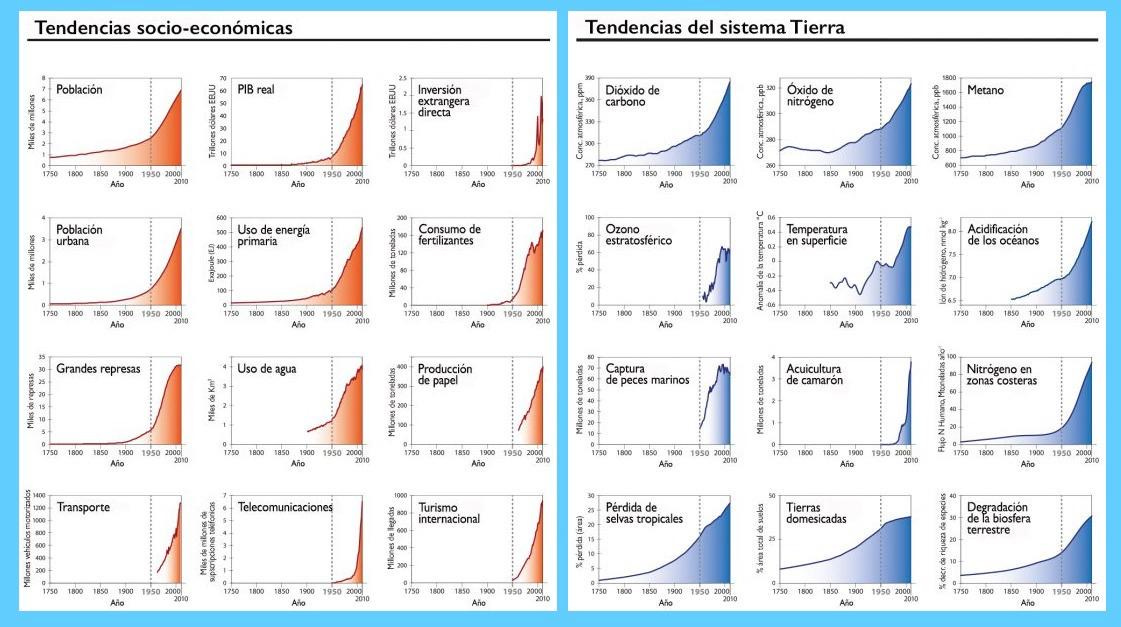
Source: Steffen et al. (2015).
The graphs already say enough.
Inflation can no longer be understood solely through monetary policy, because an energy crisis — and an unresolved transition — exists that cannot itself be separated from the global geopolitical reorganisation.
Soil erosion and increasing levels of polluting gases alter agricultural production.
That alteration affects urban dynamics and may increase incentives for migration.
Those displacements, in turn, can become raw material for new processes of militarisation.
Militarisation reorganises global supply chains.
Those supply chains are serviced by military, technological, and financial corporations.
Each process modifies the conditions of the next.
They are feedback loops.
An architecture of interdependencies.
It erodes economic stability.
It fractures the possibility of isolating what we are attempting to explain.
What happens when the very language through which we sought to map the present ceases to be sufficient?
The question is far from trivial. If the system continues accumulating capital while simultaneously destroying the material, ecological, institutional, and social conditions of its own reproduction, then perhaps we are not simply witnessing a crisis more extensive than those that preceded it.
Perhaps we are confronting a phenomenon whose logic can no longer be described through the conceptual relics of the past.
For it is not enough to claim that we are living through “an unprecedented crisis”. Every generation tends to describe its own present in such terms.
Nor is it sufficient merely to accumulate environmental or economic indicators.
A greater quantity of evidence does not resolve a conceptual problem.
It is a simplification of a particular reality under particular conditions.
It is not the totality.
What is at stake is not merely the severity of events.
It is the explanatory capacity of our concepts and categories.
III. When the Word Collapse Reappears
Those linguistic units are transhistorical.
They do not emerge spontaneously from the brain-system.
They are not static.
They are individuals that come and go.
They are born, they perish…
They are zombified.
They return as entropy increases.
When information rebels against existing categories.
The word collapse remained largely at the margins of the social sciences throughout much of the twentieth century. There was scarcely any need to think it except as a means of describing the fall of ancient civilisations.
While cookbook economics could not even patent a theory of crisis, Marxist political economy became entangled in debates between orthodox and heterodox currents over the analysis of capitalism through the category of crisis. It ventured only slightly further into theorising systemic breakdown, a perspective that would lose credibility in subsequent decades as capitalism repeatedly demonstrated its capacity for survival.
Meanwhile, the other social sciences analysed capitalism’s effects — sometimes even before understanding its operation — through discussions of modernisation, development, institutional change, and much else besides.
The reason was simple:
The acceleration of climate change.
The loss of biodiversity.
Increasingly extreme climatic phenomena.
The hollowing-out of democracies.
The tyranny of transnational capital.
Crises of overproduction and accumulation.
The intentional fragility of the financial system.
Endless and insufficient: speaking of crisis.
A transhistorical category now rendered obsolete.
Finally: thinking systemically.
Suspicions.
Intuitions.
Catastrophism?
The end of technological Prometheanism?
A chronicle of a death foretold?
Collapse as a means of designating divergent realities.
Crises feeding and feeding back into one another: the impasse.
There is no future within an anthropocentric society that already thinks from the future: incompatibility.
The message reads:
Reproducibility of society = negative.
Under what material conditions does it continue to exist = positive.
Mitigation or adaptation.
Collapse:
Problem of social complexity
↓
Problem of complex systems
↓
Biophysics
↓
Within capitalism
If capitalism represents a historically specific form of organising production, then the concepts and categories used to study the fall of earlier civilisations cannot simply be transferred to it without qualification. The capitalist civilisational project is driven by capital accumulation. Understanding how it operates is essential if its dynamics are not to be reduced to institutional structures or to the apparent rationality of textbook economics.
Capitalist society is not a civilisation trapped within an endless cycle of rises and falls.
Capitalism is a society organised through production and for production. It is a form of social organisation captured by the machine, which establishes efficiency, profitability, efficacy, welfare, and success as criteria governing human existence.
It is here that we must ask to what extent free will or human agency genuinely exists within capitalism.
Complexity compels us to begin decentring the subject in relation to the object.
Which ultimately leads us back to the same path:
Capitalism nevertheless depends upon the permanent transformation of its own conditions of existence.
In this sense, what exactly would collapse mean for a system that survives through constant crises?
The central question is not whether capitalism can collapse.
Following the most obvious logic:
How can we speak of collapse when capitalism continues to produce more technology, more artificial intelligence, more infrastructure, and greater profits?
It is an infinite crisis.
A prison in which all forms of existence remain suspended in perfect equilibrium.
Everything seems to indicate precisely the opposite:
The machinery continues to expand.
Anthropo-capitalocentric conclusion:
Everything will be fine.
There is no collapse.
Equilibrium no longer consists in suppressing crisis.
It consists in administering it indefinitely.
Capitalist neo-vampirism continues to believe that it can drain Gaia indefinitely.
That is the problem…
…within the problem.
That which survives through chaos…
…begins to erode the very conditions that made that chaos possible.
The higher singularity that has always surrounded us.
Geotrauma emerges: a condition for capitalism’s survival.
Collapse is not the end.
It is a specific form of movement.
There is no opposition between reproduction and destruction.
They operate in coordination.
Simultaneous moments of the same logic.